


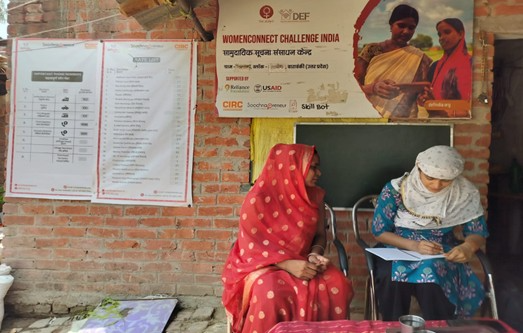
In the quiet lanes of rural Uttar Pradesh, where access to government services and digital knowledge often feels out of reach, a young woman is steadily rewriting the story. Her name is Reena Ji. A BA second-year student with a calm determination in her voice, Reena has become both a Digital Didi and a community 000changemaker—bridging gaps of access, information, and awareness.
Reena first connected with the Digital Empowerment Foundation (DEF) in 2022. What began as an introduction turned into a life-changing journey when she formally joined the She Catalyst Project in 2025. Equipped with a printer and digital devices provided by DEF, she quickly transformed into a reliable service provider for her village. Today, people turn to her for everything from income, caste, and residence certificates to pension enrolment and digital form-filling. Services that once required long travel and expense are now available at their doorstep.
But Reena’s work goes beyond documents and devices. She has stepped into a space often whispered about but rarely addressed openly—menstrual health. By spreading awareness and distributing Smartpads, she has taken on deep-rooted stigma head-on. “There’s a stigma, but I’ve never been ashamed of educating others about periods. Someone has to start the conversation, and I did,” she says, her words carrying the quiet weight of courage. In her village, such a stance is nothing short of revolutionary.
Her transformation took a leap forward in February 2025, when she attended DEF’s 8–10-hour training. The program introduced her not only to service delivery but to the vast world of digital literacy. From learning how to use WhatsApp, Facebook, and Instagram, to exploring e-commerce apps and practicing digital safety by creating secure passwords—skills once foreign to her have now become second nature. For someone who once hesitated to use mobile phones, Reena has now become a role model in digital confidence.
The results are already visible. She has sold 10 Smartpads in her village, breaking the silence around menstrual health. The children she teaches, despite being in a rural UP Board setting, now study in English-medium schools, encouraged by her example. And with her earlier experience as a community worker and Lekhpal, where she earned only ₹1500 a month, Reena has now stepped into her role as a digital entrepreneur—earning, learning, and expanding her impact. Through the e-Shram card, she also secures benefits that add stability to her journey.
Reena Ji’s story is more than individual growth. It reflects how technology, when placed in the hands of determined women, becomes a tool to fight stigma, challenge silence, and unlock futures. Her path shows that empowerment is not just about access to devices—it is about reshaping conversations, building confidence, and setting examples for generations to follow.
In the words of her neighbours, “If Reena can do it, why not us?” That sentiment is perhaps her greatest achievement.