


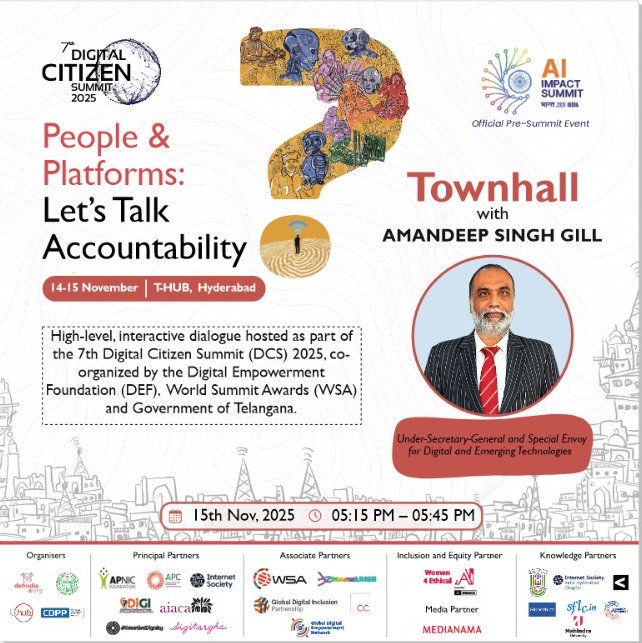
7th Digital Citizen Summit 2025 — T-Hub, Hyderabad
Theme: People & Platforms — Let’s Talk Accountability
Overview
The Townhall with Mr. Amandeep Singh Gill, United Nations Under-Secretary-General and Special Envoy for Digital and Emerging Technologies, held at the 7th Digital Citizen Summit 2025 at T-Hub Hyderabad, focused on the theme “People & Platforms: Let’s Talk Accountability.” In his opening remarks, Mr. Gill outlined the UN’s current efforts to build an open, free, secure, empowering and sustainable digital future grounded in the principles and action framework of the Global Digital Compact (GDC). He highlighted the recent establishment of global AI governance mechanisms, including the International Scientific Panel on AI, an inclusive global dialogue on AI governance, and global investment initiatives to build AI capacity across vulnerable nations.
The interactive dialogue explored critical issues such as youth participation in shaping digital norms, community rights in data governance, representation of grassroots voices in global forums, and the challenge of balancing freedom of expression with AI-driven misinformation control. Mr. Gill stressed the need for bottom-up leadership, community participation, and collaboration between governments, innovators, and civil Society.
In a closing exchange, Osama Manzar, Founder of the Digital Empowerment Foundation, raised concerns about the persistent exclusion of community voices amid top-down AI development and asked how the GDC can empower communities to demand accountability from technology providers. Responding, Mr. Gill emphasized the importance of laddered engagement models, regional collaboration, mayoral alliances, and partnerships with organizations like DEF to ensure that the GDC becomes a living, participatory, community-driven framework rather than a top-down instrument.
The session concluded with a shared commitment to ensuring that the digital future is shaped with communities, not merely for them, and that youth, innovators, and grassroots leaders hold an essential role in co-creating a fair, inclusive, and accountable digital ecosystem.
Opening Remarks — Mr. Amandeep Singh Gill
It is really a pleasure to join you and others at this iconic setting, the T-Hub. I remember vividly my visit to the T-Hub about three and a half years ago. It was truly inspiring. And I really regret that I cannot be with you in person, but it is a pleasure to join you virtually.
And the program is so inspiring, so comprehensive. Now, you asked me to share some reflections as a prelude to our question-and-answer session. What perhaps I can do is give you a snapshot, a timestamped snapshot of what the Office for Digital and Emerging Technologies at the UN, which I have the privilege of leading, is engaged on currently under this overall vision of building an open, free, secure, empowering, sustainable digital future.
And of course, this future cannot be built by governments alone, cannot be built by big corporations alone. It has to be built bottom-up by citizens, by communities, by entrepreneurs, by innovators across all sectors. Yes, entrepreneurs can exist within governments as well.
So, we need to take this community-centered, community-focused, citizen-empowering approach to building the digital future that we all deserve, that we all aspire to. And that is the main focus of the Office for Digital and Emerging Technologies. Our charter, in a way, is the Global Digital Compact, which was adopted by leaders coming together at the Summit of the Future in September 2024.
This has a set of principles, but principles are not enough. We need a Solid action framework. And we were fortunate that the Global Digital Compact (GDC) came up with this action framework across five objective areas, from bridging the digital divide and accelerating progress on the sustainable development goals, let us call it digital for development, to an inclusive digital economy, which works for all companies, all countries, all citizens, to building safety and trust and protecting human rights online, and then new areas around data governance and artificial intelligence.
Just recently, we have had a breakthrough in establishing global standing mechanisms for the governance of AI, governance in the interest of everyone on this planet. So, first of those standing mechanisms is an international independent scientific panel on artificial intelligence, which would bring together 40 eminent scientists from around the world to give us regular assessments of what this technology is, what its opportunities and risks are, and how we can craft better policies in the light of this scientific evidence. Do not think that this is just a scientific exercise, an abstract exercise, Some kind of a literature review.
This addressing of information asymmetries is fundamental to building an inclusive and empowering future with AI. The second standing mechanism is a global dialogue on the governance of AI. You know that different countries are taking their own approach to the governance of AI.
And, sometimes, these approaches can be not interoperable, they can be based on different normative frameworks. And it is important that we try to connect them somehow through this dialogue so that countries, big or small, can learn from each other. And most importantly, every country, big or small, rich or poor, has a seat at the table in crafting the rules of the road, in shaping the AI future.
So, this is the intent of this inclusive AI governance dialogue at the United Nations. A third pillar of our approach to the governance of AI for all humanity is building capacity. And this is where I like to close my opening remarks.
Capacity building is most essential for inclusive governance. The capacity of government officials to understand and deploy this technology, the capacity of teachers and students in terms of AI literacy, where is AI useful, where to apply it, where not to apply it. The capacity to understand misinformation, disinformation, defects coming from the AI misuse space.
And of course, capacity to innovate across domains, agriculture, health, education, environment, coming together with AI and computer sciences to drive progress on the sustainable development goals. The Secretary General has proposed in a report that the member states asked him to present a global fund on AI of up to 3 billion dollars for urgent investments in the 80-90 countries that are most at risk of getting left out of this AI wave. There are also preparations for better coordination among funders and also building a network of capacity building centers around the world so that we can emphasize collaboration rather than competition and scientific cooperation in terms of driving progress on the sustainable development goals through open-sourced AI models, shareable use cases, collective work on data sets, trainings and other aspects of AI capacity building.
Town Hall Q&A
Question 1
I want to ask you, Sir, how really can the younger generation really influence the global norms in terms of making the community rights a priority over corporate rights and also to add on to the global digital compact framework that we are talking about. How does it bring back to center the issues of ethics, consent and more ethical sharing of data? These two questions if you could answer, please.
Answer — Amandeep Singh Gill
Yes, sure. Thank you for your question. I think wherever I go Africa, Asia, Latin America, Europe, North America, really, the tech future is being written by young people. They are overturning orthodoxy in some of our approaches to AI. They are coming up with great innovations in terms of how infrastructure is brought together engineered in a sense for more powerful AI models, and without exception, they are all highly motivated driven by what they believe is their vision of the future.
I think if we have to shape the AI future then we have to have a dialogue. We have to have engagement and we have to have leadership from these young innovators. So, my focus is that the GDC working together with the new youth envoy at the UN should be landed in context locally where these innovators are the most active so that we can, as the conference notes also mention, ladder up the implementation of the GDC. Now, this can work in various ways.
There is of course the aspect of participation in policy discussions where youth bring their perspectives and can shape policy for a better digital future but it is also about specific themes like data. How is data collected locally? How is it governed? How do we protect the rights of people over data? So, the young innovators can set the benchmarks there, can set the bar high in terms of trusted innovation, in terms of empowering outcomes from the use of digital and emerging technologies.
Question 2
Sir, despite UN and other initiatives really trying their best to have more grassroots voices at the global table, we still see that there are certain limitations that you must have been facing in the process. I wanted to understand what those challenges are from a global lens and what are probably more diverse strategies that you are employing in dealing with such problems?
Answer — Amandeep Singh Gill
The biggest challenge today is that there is a kind of selfishness, a kind of me first that has descended on international engagement. So, to build cooperation, to build solidarity in the face of this selfishness is our biggest challenge.
There was a time when development was seen as creating a shared and let’s say beneficial future for everyone. So, today, we struggle with that, and, therefore, I think what we need to do is again: Go back to a people-centric, democratic approach where you bring the voices of the people, voices of communities, to sort of dampen this selfishness and promote solidarity, promote international cooperation over ‘my’ nation, you know, ‘my interest’ first.
Now you may have heard of other challenges around, you know, financing, around difficulties in terms of financial resources and those of course, you know, are being addressed. The Secretary General has launched the UN80 mission this year. It is the 80th anniversary of the United Nations to address some of these challenges and I am confident that by readjusting how we deploy those resources, by achieving more efficiency in the way we work and even by re-examining some of the mandates, like these are new and emerging areas and of course, the UN has to be fit for purpose.
But there are obviously old mandates that need to be re-looked at. Are they still relevant today and if they are, can we deliver them differently? So, this is important for the UN to not only, let’s say, navigate this current problem around financial resources, but also to build credibility with communities, with countries around the world that the truly inclusive platform that the UN is, cannot only ensure inclusion and the participation of diverse voices, but it can also deliver value for all countries, all communities around the world.
Question 3
With misinformation being supercharged by generative AI, how do you envision the global government’s framework balancing freedom of expression with the need for AI accountability and content integrity?
Answer — Amandeep Singh Gill
Right. So, this is one of the biggest challenges, risks we face with AI, especially its new avatar which is Gen AI. The plausibility and the believability around some of the content that is generated is very high because, you know, this technology has got better at handling text, audio and video.
So, in terms of global governance, we have a set of principles. I mentioned the Global Digital Compact (GDC), which has a set of approaches including the UN’s principles on the integrity of public information. Now the challenge for us is that these global governance frameworks need to be translated into accountability for platforms, for companies and that can only come through national law, national, let’s say, executive decisions or frameworks.
And this is where our focus at the UN is, is to work with countries that are leading this work, that are highlighting these issues. For example, the European Union, but also recently Brazil as the former chair of G20, as the current chair of the climate change discussion has taken a lead on. To give you a concrete example, recently, the UN has worked with Brazil on a set of concrete actions around misinformation and disinformation as it relates to climate change, which for us at the UN, along with the misinformation, disinformation about peacekeeping operations and health, are really critical areas for us.
We are kind of emphasizing that interface where the global guidance, the global principles meet with national actions and working with, let’s say, some leading countries, the champions of this fight against misinformation and disinformation.
Now, you mentioned this aspect of balance. I think it is very, very important in the name of countering misinformation, disinformation, or for that matter; security threats, you know, and we have seen that around the world. Sometimes, we take harsh and excessive measures, you know, internet shutdowns are one such thing.
And, we have seen how the youth can react to these kinds of harsh, excessive measures. They may be driven by good intentions, but they end up having a disproportionate impact on sustainable development, on freedom of speech, freedom of expression, freedom of assembly. So, I think, again, national governments, local governments have the duty to weigh these different aspects carefully before taking actions in this space.
And, this cannot be really written in stone. It has to be a dialogue; it has to be a constant updating and conversation.
Closing Dialogue with Osama Manzar
Osama Manzar:
Amandeep, thank you very much for making yourself available at 5.30 in the morning. That is really incredible. A couple of points. The first point is that we know you champion communities a lot in every talk, wherever you go, you do. Even the GDC, the first time that you had started, you have always talked about communities, communities, and communities. And yet, we see that in all discussions and forums, communities are continued to be left out. While the world, in terms of technology, has been completely motivated by artificial intelligence, machine learning, and that entire movement of AI is very much top down. And on the other hand, people and communities are being treated as consumers.
So, there is this whole challenge that I see for GDC. How do you see that you can take GDC in a way that you can take it forward, where you can motivate, inspire, connect and mobilize the communities to be in a responsible position to ask for accountability from all the tech providers? You know, I am asking a question: how do you see the future of GDC in terms of taking responsibility for communities being more vocal and more accountable to ask questions? And, on the other hand, what kind of support do you think that Digital Empowerment Foundation (DEF) can bring forward to GDC?
Answer — Amandeep Singh Gill
Thank you, Osama.
Now, this laddering up and combination of the top-down globally coordinated approach with the community-led approaches, I think, is a critical issue. So, how are we going about it practically in the context of the UN system coordination? I have endeavored to involve the regional economic commissions in Latin America, Africa, the West Asian region, the Asia-Pacific region, in Europe in the implementation of the GDC. So, for instance, we had a meeting recently with the West Asian region in Dubai, and earlier in Amman, where the regional agenda, the Arab digital agenda was aligned with the GDC, was aligned with the outcomes of the World Summit on Information Society (WSIS).
So, bringing it down one level, and then going further, we have been working with the resident coordinators, the UN has a network of 130 resident coordinators around the world. So, we have engaged them through workshops. In fact, we are building a suite of digital services for them, down to the extent of how they can prepare projects with stakeholders on the ground, by utilizing the language of the GDC with an AI tool. So, this aspect is integrated into the jointly developed frameworks for SDGs that the UN and its teams — the agencies — build together with the local government.
Simultaneously, we have worked with our colleagues at UN Habitat, to put together an alliance, a global alliance of mayors for digital cooperation. In New York, we have recently had this election of a new mayor. I have been in some other parts of the world where cities are taking the lead in, and the leadership of the political leadership, people like our dear friend Jayesh Ranjan, this has to be really applauded, because from that level, we can generate really context-specific innovation.
So, we want to engage the mayors on this issue. Now, you asked, at the end of your question, how can the UN better engage with organizations such as the Digital Empowerment Foundation because these layers of, like, say, either international organizations or governments, that is one thing. But then we have to try and reach communities in as many ways as we can.
So, this is where the work of the Digital Empowerment Foundation, the World Summit Awards, and more than 1000 of those who have come forward to endorse the GDC principles becomes very important. So, we are keeping up this engagement through townhalls, through interactions such as the one today. We are leveraging other partners across the UN, UNCTAD, UNIDO, UNDP, and so on. We are also building up, and I think this is something where we can amplify this work.
These new avenues for collaboration, to give you two examples, a new open-source week, this is the third year that we have done this, where the open-source community, again, which is closer to the community, comes together, the digital public goods, work that is being done, has a profound link to open-source, democratization of AI, if you look at open and shareable models, what is going on in many parts of the world, China, for example, again, there is a profound link there. So, this open-source week has become a go-to place for hundreds of open-source enthusiasts to come together. So, a set of principles, which recently South Africa has endorsed, the city of Barcelona has endorsed, has come out from that engagement.
The second example I want to share with you is a DPI summit. Digital Public Infrastructure (DPI) has been profoundly transformative in India. For example, I have seen it firsthand, you all have seen it firsthand; this paradigm is now spreading throughout the world.
But there was no place where this community of DPI thinkers, DPI builders, people who worry about DPI safeguards, or, you know, quickly taking DPI to Africa to build an integrated continent-wide digital economy, there is no place for this community to come together. The second year of the DPI summit, the first one was in Cairo. Second one, we stayed in Africa, because that is where the interest is the maximum, the need is the maximum. So, this year, it was in Cape Town earlier this month. So, these are some ways in which we are endeavoring to take a more laddered up approach to it.
And Osama, really, thank you so much for partnering with us to ensure that the GDC is not just some kind of an abstract, global top-down framework, but it is a living organic, bottom-up approach to building an open, free and empowering digital future.
Osama Manzar:
Thank you. Thank you so much for this most crucial dialogue and for joining us today.
Amandeep Singh Gill:
My pleasure. Thank you.
To access the document, please download here