


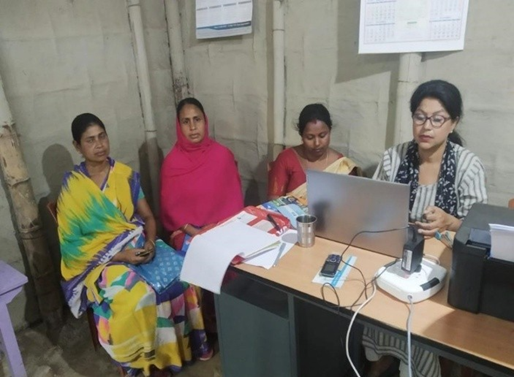
In Malibari, a quiet village in Bihdia Jajikona Block of Assam’s Kamrup district, a quiet transformation is taking root. At the center of this change is Sajiya Choudhury, a woman who has made it her mission to connect rural women with the opportunities that government schemes and digital tools have long promised but seldom delivered.
For years, women in her community struggled with the most basic entitlements as ration cards, pensions, loans, or access to healthcare schemes. The gap wasn’t due to lack of interest or ambition. As Sajiya observed, “The desire to learn and earn was there, but most women didn’t know where to start or whom to ask.” This realization became her call to action.
She started small—by setting up a Soochnapreneur Business Mitra (SBM) Centre inside her home. What began as a modest corner service gradually evolved into a dedicated space built right in front of her house. Today, her centre has become a trusted hub where women walk in not just with questions but with hope—whether it’s about securing benefits under schemes like PM Ujjwala Yojana, Jan Dhan Yojana, Sukanya Samriddhi Yojana, MUDRA loans, or food security entitlements.
Over time, Sajiya has reached more than 100 Rural Women Entrepreneurs (RWEs), guiding them through the maze of forms, documents, and online processes that once felt impossible. She has trained women in digital literacy, helped them register their ventures, facilitated FSSAI licenses for food businesses, and connected them with banks to access credit under government financial inclusion programs. Each interaction has turned an inaccessible scheme into a stepping stone for empowerment.

But she didn’t stop at one-on-one support. Recognizing that awareness had to precede action, she began holding village workshops—breaking down complex policies and digital processes into simple, relatable steps. From demonstrating how to make a digital payment to showing how to track application statuses online, Sajiya turned government schemes from distant promises into everyday realities.
The results are striking. Women who once hesitated to touch a smartphone now use it to apply for benefits, make online transactions, and explore digital marketplaces. Small entrepreneurs have formal recognition, food vendors have licenses, and mothers know how to secure scholarships for their daughters. As Sajiya proudly shares, “Earlier, they came with doubts. Now, they come with plans.”
Her work is not loud or dramatic, but deeply transformative. By turning entitlement into access, and access into confidence, Sajiya has built more than a service centre; she has built a bridge of trust. From her modest home in Malibari, she is quietly rewriting what empowerment means for rural women: one scheme, one skill, and one success story at a time.