


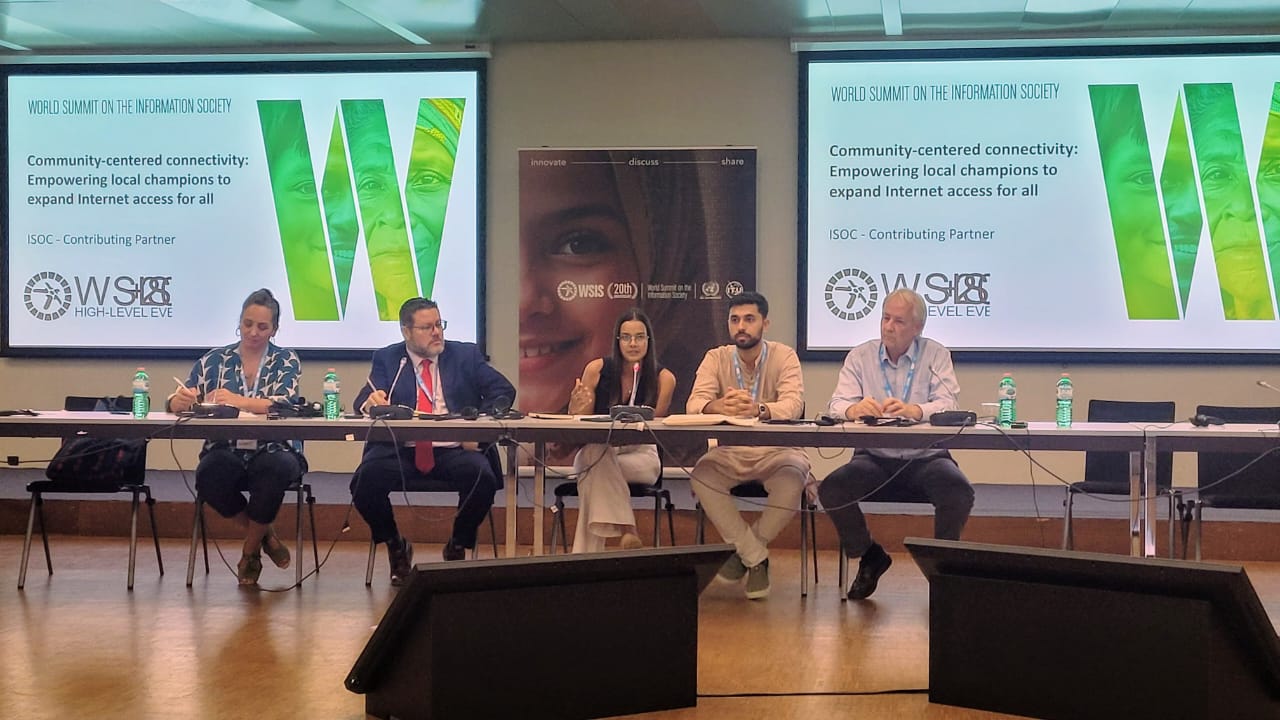
From 7–11 July 2025, Geneva became the center of global digital dialogue as the WSIS+20 High-Level Event and the AI for Good Global Summit brought together 11,000 participants from 169 countries. Two decades after the first WSIS, the conversations in Geneva reflected on progress made while confronting the urgent questions of our time: how do we ensure digital transformation remains inclusive, democratic, and equitable?
For DEF, the answer began with lived experience from the ground. At the Knowledge Café: Youth Building the Digital Future, DEF shared insights from its SoochnaPreneur program, showing how rural youth in India are using digital entrepreneurship to not only access information but also lead change in their own communities. In discussions on connectivity, DEF highlighted community networks as sustainable, trust-driven models that empower local champions to bridge the last mile. Across sessions, one message resonated clearly: digital inclusion is democratic inclusion. Without access, skills, and trust, millions risk being excluded not only from technology but also from civic life itself.

Alongside WSIS, the AI for Good Summit offered a parallel stage where the promises and perils of artificial intelligence were debated. DEF brought a strong reminder that innovation without access risks leaving billions behind—2.6 billion people still remain offline. At the Partner2Connect track, DEF emphasized how digital capacity-building lays the foundation for AI to deliver real value in underserved communities. Through its Just AI initiative, DEF also raised concerns over the concentration of AI patents and decision-making in a few countries, calling for inclusive governance where affected communities have a genuine voice in shaping standards and frameworks.
Perhaps most compelling were the hyperlocal case studies DEF presented: AI-enabled crop disease detection supporting farmers, indigenous-language tools breaking barriers of exclusion, and community-driven connectivity proving that sustainable solutions emerge when designed with, not just for, the people. These examples served as living proof that technology achieves its true potential only when rooted in grassroots realities.