


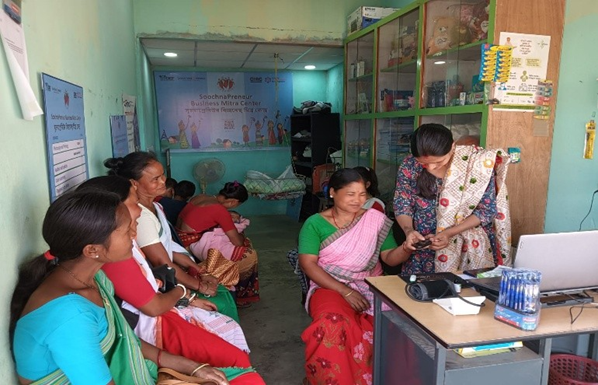
In the quiet villages of Assam, digital services were once a distant dream. Residents often had to travel nearly 15 kilometers to access something as basic as a pension form or a ration card application. For many, especially women, the cost, time, and effort involved meant that essential services remained out of reach.
Among those affected was Suman Sharma, a homemaker and bookkeeper of her local Self-Help Group (SHG). Dependent on her husband for daily expenses, Suman lived a modest life but nurtured a quiet aspiration: to build something of her own while serving her community. She had witnessed first-hand how the lack of access held her village back. Deep down, she knew that if women could access services closer to home, it could unlock both independence and opportunity.
Her turning point came with the intervention of the Digital Empowerment Foundation (DEF). When DEF introduced digital centers in her region, Suman seized the chance to transform her life. With their support, she set up her own digital business facilitation and service center—a bold step that marked the beginning of her journey from a dependent homemaker to a digital entrepreneur.
Starting small, she immersed herself in learning. From handling digital devices to delivering services, Suman steadily built her confidence and skills. Soon, she began offering much-needed services to her community: access to government schemes, e-governance solutions, banking assistance, marketing support, and digital literacy training.
Through her center, villagers could now apply for and benefit from welfare schemes such as Pradhan Mantri Jeevan Jyoti Bima Yojana (PMJJY), MGNREGA job cards, pension enrollments, ration card services, and ABHA Health IDs. For the first time, these opportunities were available within the community itself—without the long, costly journeys that once kept people away.
But Suman’s impact did not stop at service delivery. After a year of hard work and training, she emerged as a digital literacy trainer herself. Today, she mentors and counsels Rural Women Entrepreneurs (RWEs), teaching them digital bookkeeping and guiding them in business management. In doing so, she has helped women not just learn, but also earn—contributing to the growth of a sustainable rural business ecosystem.

This transformation has been life-changing for Suman too. From once depending on her husband, she now enjoys financial independence, earning an average of ₹25,000 per month. Her role has shifted from homemaker to mentor, from service provider to community leader. She has become a role model for women in her village who now see digital literacy not as a distant skill but as a pathway to empowerment and livelihood.
Suman Sharma’s story is a testament to the transformative power of opportunity, support, and self-belief. With the right tools in her hands, she has not only changed her own life but also lit the path for many others. At the grassroots level, her journey shows how digital empowerment is not just about technology—it is about dignity, agency, and the ability to shape a better future for the entire community.