


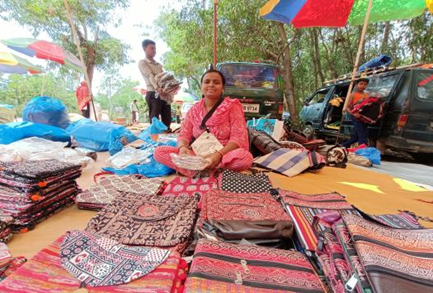
In the quiet village of Lohagarh in West Bengal’s Birbhum district lives Fatema Khatun—a woman whose quiet determination has stitched together not only her own path to independence, but also new possibilities for other women in her community.
Born into a poor family, Fatema’s early years were shaped by scarcity. Her father worked as a daily labourer, her mother managed five children within the walls of a mud-brick home, and education beyond the basics was never an option. At 19, she was married. Her husband’s modest earnings as a watchman kept food on the table, but little else. “There were days when even basic needs felt like luxuries,” she recalls.
It was in those difficult moments that Fatema remembered a skill her mother had passed down to her—stitching. With no savings and no machines, she started with the simplest of efforts. Two hand-stitched bags, sold at the local market, became her first step forward. The small success ignited a spark. “That day I realised, maybe I can build something of my own,” she says.
From that point, Fatema’s life began to change stitch by stitch. She experimented with embroidered purses, jute bags, and beaded items, carrying her work to Sonajhuri Market and nearby haats. Slowly, her colourful designs began to attract attention. Encouraged by buyers’ responses, she took a ₹40,000 loan from her village Self-Help Group. With better cloth, threads, and mirrors, she elevated her craft, mixing traditional kantha stitches with modern touches.

Within months, Fatema’s monthly earnings grew to ₹8,000. For the first time, she was not just supporting her husband—she was paying for her child’s school fees, buying household essentials, and even saving. But she also remembered what it felt like to feel powerless. Determined not to let other women remain in the same place, she began training three young women from disadvantaged families. Her small unit turned into a collective, where skill-sharing and solidarity created both income and confidence.
The path was far from easy. Rising raw material costs, irregular demand, and social skepticism often challenged her resolve. “What can a village woman do with just thread and needles?” people scoffed. But Fatema refused to be discouraged. She learned to keep simple records, to negotiate with suppliers, and to adapt her designs to customer demand. “Every order taught me something new,” she reflects.
By 2023, Fatema upgraded her sewing machine and expanded her team. Her income crossed ₹15,000 a month. She repaired her one-room tin shed into a stronger concrete home, invested in her child’s education, and gained respect in her village. People who once mocked her now came for advice. “I may not have studied much, but I’ve built something with my hands,” she says with quiet pride.
Today, Fatema is taking her craft into the digital world. With training from the Digital Empowerment Foundation, she has learned to use WhatsApp and Facebook to showcase her products. She dreams of opening a store called Fatema’s Handicrafts in the nearby town and of building a digital marketplace that connects women producers from surrounding villages. “If we come together, we can earn without leaving our homes. Every woman deserves that chance,” she says.