


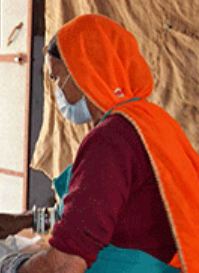
People often begin to slow down or think of retirement as they approach the age of sixty. However, that is not the case for Bodhi Devi, a sixty-year-old woman from Tilonia, Rajasthan, who has been actively working with Barefoot College for the past three years, ever since the untimely passing of her husband due to a heart attack. Residing on campus with her two sons, daughters-in-law, and four grandchildren, while her two daughters live in nearby villages—Bodhi Devi is part of a larger movement of empowered women in Tilonia. Thanks to the visionary work of Bunker Roy and his team, she, like many others in her village, has become far more aware of issues related to health and sanitation, breaking the silence around menstruation and treating it not as a taboo but as a natural and essential topic.
Bodhi Devi, along with three other women—Lada Devi, Netal Devi, and Shanti Devi—runs a low-cost sanitary napkin production unit located within the Barefoot College campus. These women manage everything themselves, from procurement to production and even distribution. While they occasionally require a male driver to reach nearby villages, Bodhi Devi hopes that one of the women will soon take the wheel. Their special cotton is sourced from Pune and processed using cotton batting machines to form absorbent strips. These are then treated with adhesive, layered on plastic sheets, shaped using advanced heat-press cutters, sanitised, and packed into boxes priced affordably for rural women.
Each sale is meticulously recorded, and the revenue generated is reinvested into the unit to sustain operations. These women also travel across the Jaipur, Ajmer, and Kishangarh districts along with visits to 30 local balwadis—to educate women on menstrual hygiene and to advocate for the use of sanitary products. Their efforts have made a significant impact: women in Tilonia no longer use unsafe materials like sackcloth or old rags during their periods.
While producing sanitary pads is commendable, what makes this initiative truly revolutionary is the normalisation of menstruation in the village’s public discourse. Unlike many remote areas where superstitions lead to ostracising menstruating women, Tilonia’s women are not isolated or shamed. This cultural shift is the outcome of years of awareness and education, values that resonate with the principles of the Digital Empowerment Foundation. DEF’s long-standing commitment to digital literacy and rights-based empowerment in Tilonia complements and strengthens such progressive grassroots initiatives.
These four women represent more than just local entrepreneurship; they are harbingers of health, dignity, and change. With a future for expanding their reach through e-commerce and social platforms, they are poised to bring affordable menstrual products to women across India, marking yet another milestone in rural India’s journey towards digital and social empowerment.