Episode 24 and 25: Lending Hands
Kapil is a 31-year-old truck driver from a village near Palwal Haryana, who selflessly helped the migrant workers who he came across on his way back from a delivery.


The pandemic has significantly disrupted the education sector- which is a critical determinant of a country’s economic future. In India, 320 million students have been affected by COVID-19 school closures, and though the government quickly recommended shifting to “online teaching,” this ignores India’s immense digital divide—with embedded gender and class divides.
The 2017-18 National Sample Survey reported only 23.8 percent of Indian households had internet access. In rural households (66 percent of the population), only 14.9 percent had access, and in urban households only 42 percent had access while only 12.5 percent students have access to smartphones. Therefore, the majority of counterparts in education sector have completely shut down for not having access to e-learning devices or solutions and thus creating a long term societal and economic impact on the young learners of rural households.
Kapil is a 31-year-old truck driver from a village near Palwal Haryana, who selflessly helped the migrant workers who he came across on his way back from a delivery.
Vijay Nath and Sanjay, migrant workers who came in search of work to Badli, Haryana, shared- “We didn’t have any money on us when we left and no money for food at home as well.”
The ordeal migrant labourers are going through is possibly one of the greatest human tragedies witnessed in recent decades. The government’s efforts at improving the plight
Sandeep and Lal Bahadur, migrant labourers from Bettiah, Bihar, shared— “We couldn’t find a bus to Bihar from Kashmiri Gate.
“Betul, a remote village in Madhya Pradesh has several daily wagers as residents who don’t have money to buy even the basics.
“This pandemic is not only a threat to human health but also to the constitutional framework.The representatives are ensuring that the democratic polity…
‘The impact of COVID-19 on health sector is not as bad as it was thought to be which is not to say that the virus hasn’t had a serious negative impact on India.
People in Narkatiaganj, Rampur and Bettiah are following the norms of lockdown, but those who are in the villages, they haven’t taken it seriously. People have to mandatorily wear masks…
“There is a shortage of masks and sanitizers in West Champaran and people do not have money to afford one. “There is a shortage of masks and sanitizers…
“Rustampur has a population of 500 people and 2 COVID-19 positive cases have been reported. People are panicked and there is an atmosphere of fear in the village.
“The Planet is hitting backwards and it is a situation of a human crisis within the Planet’s existence. The situation is such that we all are isolated and quarantined…
“In Nuh, despite lockdown Samar Khan and his team have been on the go to serve people. Unfortunately, there is a lack of awareness and understanding when it comes…
“In Barabanki the weavers are in trouble due to the crisis. They have not been paid for the previous orders because there is no way of transporting the products.
“Villagers are contributing rice, wheat, potato and oil—and we have prepared food packets to help others who are struggling. Since this is the harvest season, every family in the village…
“The immediate effect of lockdown on the villagers is that—it has become extremely difficult for them to step out of their respective homes, even for urgent requirements.
“I am at Channenhalli village which is 60 kilometres away from Tumkur district in Karnataka and am connected with Mr. Manzar through the internet.
“India with regards to the spread of the virus is nowhere close to peaking—and currently it is only at the tip of the iceberg. The dynamics of the country—the lifestyle…
“Off late, biometric to avail ration has been stopped and instead OTP mechanism has been put in place. Since this the only option, people are unable to avail it because either they don’t have a registered…
“According to my observation, the migrant workers are the worst affected in Goa, especially in Saligao. In Goa, thousands of labourers who are daily wagers…
“ISAP is a large network of agriculture and allied sector of professionals in India and acts as a bridge between Indian rural communities and other government corporate entities.
DEF launched the Digital Emergency Relief Programme through its Community Information Resource Centers (CIRC) across 600+ locations in India who have been rigorously responding to the crisis by reaching out to the most vulnerable communities. Read More
The informal sector in India comprises of close to 81% of the employed1 workforce with 77% coming under the category of vulnerably employed. A significant proportion of this category is comprised of seasonal agricultural migrants. Read More
COVID-19 pandemic has changed the daily routine of people’s lives. On March 25, the government of India announced nationwide lockdown till April 14, 2020, again extended… Read More
India is unique in culture, geographic pattern, community settlements, economic or natural resources. There is wide regional disparity in development within the country. As a result, people living in rural parts belonging… Read More
“बीमारी से लड़ें कि भूखमरी से. अच्छा किसको लगता है जान जोखिम में डाल कर खाना लेना. घर भी जाना चाहे तो उसके लिए भी पैसे नहीं हैं.” Read More
दिल्ली में पंजीकृत मजदूरों की संख्या में लगातार कमी होने पर भी सवाल उठ रहे हैं। दिल्ली श्रम कल्याण बोर्ड में पंजीकृत हैं सिर्फ 46,000 पंजीकृत मजदूर जबकि 2015 में यह संख्या 3 लाख 17 हजार थी।. Read More
मनीषा देवी राशन कार्ड का आवेदन दिये हुए 2 साल अधिक हो चुके हैं, लेकिन उन्हें अब तक अपने राशन कार्ड का इंतज़ार है. अलग-अलग राज्यों में लाखों राशन कार्ड के आवेदन सरकारी फाइलों में धुल खा रहे हैं. Read More
लिंचिंग को लेकर सरकार के द्वारा उठाये जा रहे क़दम, सरकार की मंशा पर ही बड़े सवाल खड़े कर रहे हैं. क्या इन बदलावों से सरकार सच में लिंचिंग रोकना चाहती है या कुछ और? Read More
लिंचिंग एक विशेष प्रकार की राजनीति से प्रभावित होती है, जिसका हल सोशल मीडिया के नियमों में बदलाव लाकर नहीं किया जा सकता. Read More
सरकार को फेक न्यूज़ के तंत्र को रोकने के लिए अन्य प्रभावी उपायों पर ध्यान देना चाहिए, सोशल मीडिया में ऐसे बदलाव पत्रकारों को अधिक खतरे डाल सकते हैं. Read More
लिंचिंग के संदर्भ में सरकार द्वारा किये जा रहे सोशल मीडिया के नियमों में बदलाव को लेकर आम आदमी असहज दिख रहे हैं. उन्हें डर है कि ऐसे बदलावों से उनकी निजता प्रभावित होगी. Read More
सोशल मीडिया के नियमों में किये जा रहे बदलावों में अस्पष्टता के कारण अभिव्यक्ति की आज़ादी से लेकर निजता तक तमाम तरह के सवाल उठ रहे हैं. Read More
As of last year, India is the fifth largest economy in the world (IMF), and business is booming. International trade partnerships with China and the USA flourish year on year, and 271 million people have been lifted out of poverty in the past decade (UN). Read More
To stave off mass hunger, the government has offered 5 kg rice and 1 kg pulses to only ration-card holders, leaving 100 million poor Indians ineligible because the master list uses nine-year-old data. And thousands with ration cards find them useless. Read More
“Ab hamein ghar jana hai, hum bohot ruk liye” (We want to go back home now. We have waited long enough), said Bharat Yadav, who was one of the many migrant workers walking back home because of no work and desperation. We met them on the way to Nuh, Haryana. Read More
The article tries to understand the chronology of events that started rumors, fake news and misinformation about COVID-19 that eventually managed to spread across the communities. It highlights the conditions that provide a fertile ground for rumors… Read More
Almost 27 years ago the World Wide Web rolled out the red carpet for the public without discrimination. Yet, today we stand here still talking about a digital divide that continues to exist, pushing people further into marginalisation, now more than ever before. Read More
“There is a crisis of a condition that has happened in our lives as the members of the human society. The condition being that we are now isolated and our regular interaction suddenly disrupted. Read More
Digital Empowerment Foundation was a part of WSIS-2003in Genevaand was foundational member of World Summit Award (WSA). Read More
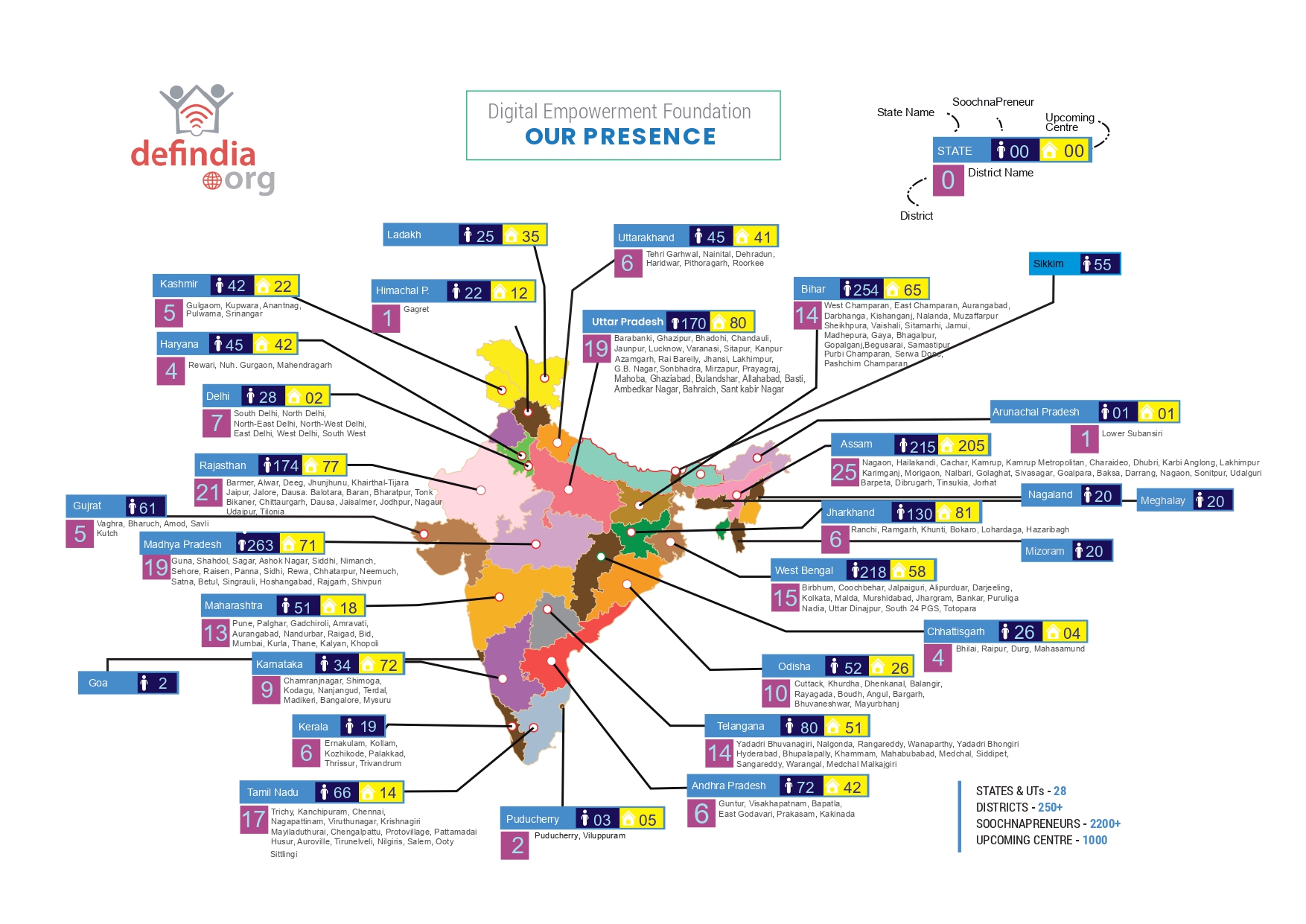
The Digital Empowerment Foundation (DEF) has been working on the ground through their 10,000 digital foot soldiers in 600 locations across 130 districts in India. DEF has been conducting… Read More
“Essential items have become costlier. Now, getting food is becoming difficult because there is no work or earning,” said Mohammed Shiraj Ansari from Saidanpur cluster of Barabanki in Uttar Pradesh… Read More
“We need immediate help to ensure our mobiles are working and we can make calls,” said one of the migrant workers stranded on the road from Delhi towards Bundelkhand. Read More
The fight against COVID – 19 should not divert attention away from digital inclusion but focus on it as a centre – piece of public health policy. Read More
US India Policy Institute (USIPI) a Washington, DC, based policy think tank and its partner Digital Empowerment Foundation (DEF), New Delhi have jointly instituted a social survey… Read More
Shivkumari, an Internet Saathi from Rewa, Madhya Pradesh, is currently producing 300 masks per day and is supplying it to the local hospitals. Read More
With new cases reported every day, corona virus has disrupted the people’s life globally. The pandemic has had a major effect on the entire social and economic structure of the society. Read More
Roti, Kapda, Makan (trans. Food, Clothing, and Shelter) has been the refrain resonating throughout India’s tryst with social and economic development from Independence until the present times. Read More
With employees and students retreating from physical gatherings, government agencies are looking at bolstering digital capacities to handle the shift. Read More
DEF has been working towards the betterment of the community amid the pandemic. With 10,000 digital foot soldiers across 130 districts in 23 states, it has been instrumental in providing ration, government entitlements, relief kits, vital information and banking services to keep people safe and healthy during this crisis.
As people complete over 50 days of lockdown with their families, migrant workers across India are still struggling to figure out means to reach their homes. Stranded with no food or water and very little help from authorities, DEF in an effort to help, distributed relief kits packed with cooked food, soaps, masks, milk, Glucon-D, biscuits and a water bottle.
Due to the lockdown, people are not able to visit doctors or health clinics for non-Emergency/Preventive healthcare. Healthpreneur (Health Entrepreneur) at DEF centers with DocOnline, an online doctor consultations platform available in multiple languages, are facilitating in conducting basic tests and doctor consultations through video or tele-calling.
Damyanti Kushwaha is an Internet Saathi from the village of Taudiyaar in Rewa, Madhya Pradesh. She has been able to make numerous mask to help her community members and aims to stitch at least 3,000 more.
Nazmeen Ansari is a part of the Digital Clusters Development Program (DCDP), initiated by DEF in the weavers cluster of Chanderi, Madhya Pradesh. She has set herself up on the task of making masks out of vegetable bags amid the Covid-19 pandemic. Even shortage of raw materials has not put a dent in her motivation to serve the community.
Yusuf Khan, a world renowned Bhapang player, is on a mission to digitalise dying folk music of Mewat area in Alwar, under Digital Empowerment Foundation (DEF). Over 100 local and folk artists visit his computer centre to book tickets online, contact international music organisations along with creating their websites and digitalising their music.
Under Digital Emergency Relief Program—DEF’s Smartpur project team in Nuh, Haryana, has been working tirelessly to provide basic essentials and government entitlements to all those in need because of the Covid-19 situation. They are also spreading awareness about the virus.
During Covid-19 crisis—Gurudev, a SoochnaPreneur in Alwar, Rajasthan, conducted a survey to prepare a list of those who are in dire need of food. He created a kit which includes—500 gm cooking oil, 500 gm lentils, 5 Kg wheat and 1 Kg rice—and distributed it amongst households in need in the area.