



Workshop for DGSEA Educational Tour at MoDS
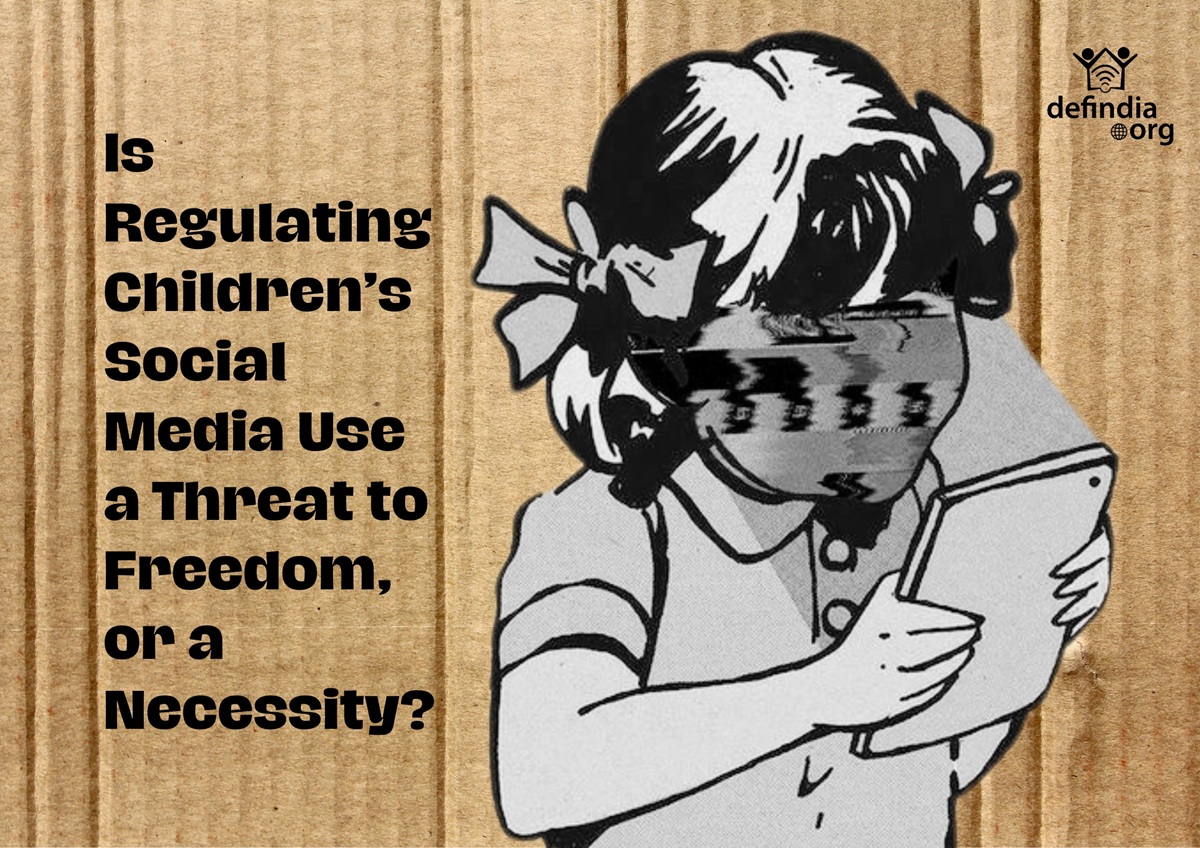
The current debate around banning social media for children under 16 has been framed as a question of freedom. It is not. It is a question of how societies protect children in environments they do not fully understand or control.
Restrictions on children are not new. Every society, whether through film certifications, access to certain spaces, or cultural norms, has always drawn boundaries around what is appropriate for young people. Seen in that light, regulating children’s access to social media is neither radical nor regressive. It is consistent with how we have always approached childhood.
The real issue is not just the content on social media, but the nature of the medium itself. Social media today is not a neutral platform. It is an algorithm-driven system designed to maximize engagement and monetize attention. What children see is not determined by what is good for them, but by what keeps them hooked and what serves advertisers.
It is also important to recognize that social media was never intended to build a knowledge society. It emerged from private, profit-driven companies, not from public institutions or educational frameworks. While it may occasionally be used for learning, that is incidental, and not its purpose.
There is another misconception worth addressing. Social media is often described as “social,” but in practice, it creates an individualized ecosystem. Children log in alone, consume content alone, and engage without the visibility or accountability that exists in real-world social settings.
In the physical world, a child is almost never alone. Whether at home, in school, or on a playground, interactions are collective, visible, and socially regulated. This is not surveillance, but the fabric of social life. Social media, by contrast, places children in a private, unsupervised environment where exposure is invisible and often unmoderated.
For children in a formative stage of life, this has real consequences. It creates parallel worlds of comparison, validation, and pressure that are disconnected from reality. It exposes them to content without context, guidance, or shared interpretation. That is not a trivial concern, but a developmental one.
Seen this way, restricting access to social media is not a violation of freedom of expression. Social media platforms do not inherently provide knowledge; they host user-generated content, much of which is entertainment-driven and optimized for engagement. Placing reasonable boundaries around such environments for children is a protective measure, not censorship.
A simple way to understand this is through analogy: we would not allow children unrestricted access to spaces that are not designed for them. Asking them to stay away from certain digital spaces is no different from advising them not to enter a mall or environment that may expose them to harmful influences.
At the same time, it is critical to separate social media from digital learning. The proposed restriction does not ban the internet or online education. Schools, digital classrooms, and educational platforms remain unaffected. Social media is not pedagogy; it is a communication and engagement tool.
Questions around enforcement, especially in contexts where devices are shared are valid. But implementation challenges should not overshadow the legitimacy of the concern. The intent is to create safer digital conditions for children, not to design a perfect enforcement system on day one.
However, how this is implemented matters deeply. Linking access to Aadhaar or any sovereign identity database would be a serious mistake. Social media platforms are private entities. Allowing them access, directly or indirectly, to sovereign citizen data raises fundamental privacy concerns.
Instead, simpler and less intrusive methods, such as school-issued ID cards, can serve as age verification mechanisms. These are already part of a child’s everyday ecosystem and do not require the sharing of sensitive national data.
More importantly, the burden of enforcement should not fall on children. It must lie with the platforms. Governments should ask a simple question: how are underage users being allowed on these platforms in the first place? The onus must shift from users to platform accountability.
The role of the government, in this context, is clear. It must act as a protector of citizens’ rights, not as a partner to private platforms in data-sharing arrangements. Safeguarding privacy and ensuring accountability must go hand in hand.
The larger point is this: social media, in its current form, is an individualized, algorithmically controlled, profit-oriented environment that does not align with the developmental needs of children.
Recognizing this is not moral panic. It is a social responsibility.
A well-designed restriction, implemented with care for privacy, accountability, and practicality, is not just justified. It is necessary.
Related posts


