


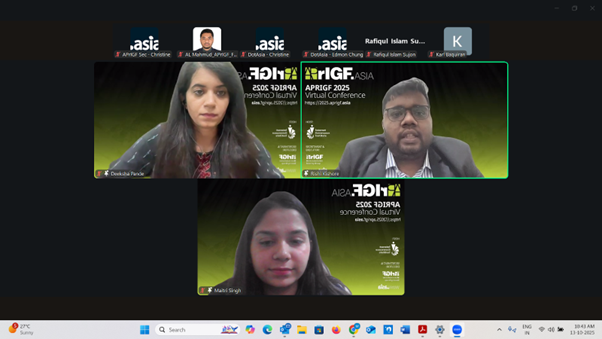
On October 13, 2025, the Digital Empowerment Foundation (DEF), in collaboration with Swaniti Initiative, participated in APRIGF AISA 2025 with a lightning talk titled “Digital Dilemmas in Just Transitions: Lessons from India’s Coal Heartland.” Asia Pacific Regional Internet Governance Forum (APrIGF) serves as a platform for discussion, exchange and collaboration at a regional level, and also where possible to aggregate national IGF discussions, ultimately advancing Internet governance development in the Asia Pacific region.
The session explored how digital technologies can support equitable energy transitions in Jharkhand’s coal-dependent districts of Ramgarh and Bokaro, while also highlighting challenges and limitations in implementing digital solutions. DEF was represented by researcher Maitri Singh, who spoke alongside Rishi Kishore from Swaniti Global, with the session moderated by Deeksha Pande.
Rishi explained the concept of a Just Transition, stressing that phasing down coal to meet Paris Accord targets will significantly affect local economies and livelihoods. The study of Ramgarh and Bokaro revealed low awareness about diversification opportunities, limited access to finance and markets, and the importance of proactive government planning. Digital technologies, he noted, could catalyze awareness, improve financial inclusion through fintech, and connect local producers of forest and agricultural goods to wider markets. Opportunities also exist in tourism and land repurposing for digital infrastructure, positioning technology as a key enabler of post-coal economic regeneration.
Maitri highlighted the limitations of digital interventions. With 47 percent of Indians offline and women 33 percent less likely to access the internet, she stressed that digital solutions could exacerbate inequalities if not paired with capacity building, community engagement, and infrastructure improvements. She also cautioned against over-reliance on AI data centers and the gig economy, which often lacks social protections, emphasizing the need for equity-focused planning.
In concluding recommendations, DEF’s initiatives like SoochnaPreneurs were highlighted as vital for community capacity building, connecting self-help groups (SHGs) to markets, and strengthening digital literacy. Bridging infrastructural gaps, subsidizing digital tools for women, and grounding solutions in local realities were emphasized as essential for truly inclusive and resilient transitions.
The session concluded by reaffirming that while digital technologies hold immense potential to enable just transitions, their implementation must be equitable, inclusive, and grounded in the socio-economic realities of India’s coal heartlands.