


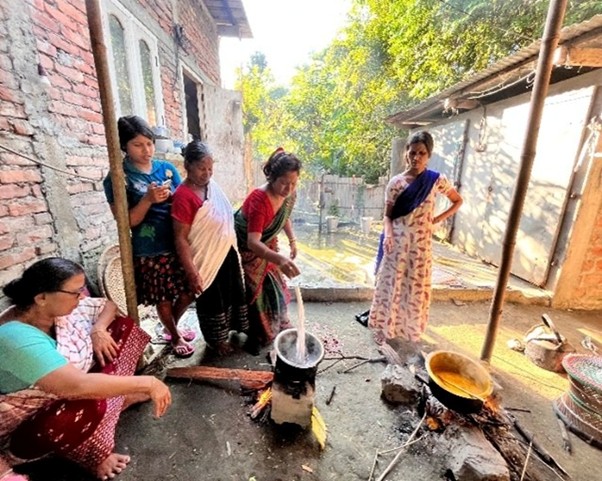
At 40, Meenakshi Das has spent more than two decades with her hands immersed in thread, colour, and tradition. Introduced to spinning and weaving by a local NGO in 2002, what began as a simple activity gradually became her identity—and a pathway to uplift other women in her community.
Meenakshi dedicates about three hours each day to spinning. Over the years, her passion and persistence helped her establish a small spinning and weaving unit in her village. Today, 15–20 women work with her, mostly in the spinning process. She is also recognized in the community for assisting with village-level surveys alongside the block office, which provides her with supplementary income.
Her commitment to weaving encouraged her to seek training from multiple government and non-government institutions. With time, she became highly skilled and confident in her craft. Yet she noticed that many women from her village—who once shared this passion—could not progress the way she did.
“They never got the kind of exposure I did. That’s why many gave up,” Meenakshi reflects.
Despite her experience, her monthly income remained around ₹3,000, constrained by limited demand and a lack of marketing opportunities. She admits that she had never maintained proper records of her work, which made it even harder to expand.
Her turning point came in 2022, during a pilot study by the Digital Empowerment Foundation (DEF). It was here that Meenakshi was first introduced to digital tools that could help her market her products and manage her business more effectively. It opened a new world for her.
Since then, Meenakshi has embraced digital platforms with enthusiasm. She now actively uses Facebook, WhatsApp, and Instagram to showcase her products and even created a dedicated Facebook Page for her weaving unit. Her willingness to learn soon led to a new opportunity.
Connected with DEF’s Soochnapreneur Business Mitra (SBM) Center at Bihdia Jajikona block in Kamrup, Meenakshi was invited as a Master Trainer to train 30 women in Natural Dyeing.
“I was so happy. DEF gave me this exposure. I never thought I would be the one training others,” she says with pride.
Her association with DEF broadened her vision. She now dreams of opening a Soochnapreneur Business Mitra Center in her own village, one that would offer digital services and support other women trying to establish their own enterprises.
Identifying a major challenge faced by local weavers, the difficulty of obtaining good-quality yarn, Meenakshi has already taken action. She launched a pilot business counselling service from her home and established a Yarn Bank. This initiative ensures that women in the village no longer need to travel long distances to buy yarn. They can now access high-quality yarn in various colours at subsidized rates directly from Meenakshi’s center. This saves both time and cost, while helping maintain a steady production cycle. She also aims to connect these women to both online and offline markets for better earnings.
Eager to keep up with changing consumer preferences, Meenakshi now wants to learn Computer-Aided Design (CAD). “Designs are changing. Customers want new patterns. If I learn CAD, I can innovate more—and teach others too,” she says.
Her vision goes beyond personal growth. She wants to guide and support women in turning weaving into a sustainable livelihood, one they can proudly own.
Meenakshi’s journey is one of quiet determination and steady progress. From spinning alone to mentoring women and introducing a community-led yarn economy, she is helping preserve tradition while shaping a brighter future for herself and others.
With the continued support of DEF’s SBM model, Meenakshi is proving that even small interventions can spark meaningful transformation in the lives of rural women.